What is your ontology?
What Is Your Ontology?
Why understanding it matters for your life and ministry—and for ethically engaging the age of AI
The Inner Frontier
The pastoral intern at the congregation I currently serve recently preached an extraordinary sermon. Like, it was incredible.
I need to make clear that this is not an unusual thing. He's been on staff for eight years and has preached semi-regularly during that time. Now into his third year of seminary and six months into his internship, he comes to the task of preaching with quite a bit of experience under his belt.
I've been the interim at the congregation for two and a half years now. His preaching has grown tremendously just during my time here.
But there were markers in the sermon - theological connections with existential relevance that were wonderfully surprising. It was just so tight. If you are a preacher you know what I'm talking about. This was the 25 hour sermon with 20 years of experience behind it, the kind no preacher in full time ministry has the time to prepare for.
During supervision the following week I asked him: "How are you utilizing AI in your sermon preparation?" I wasn't concerned that his AI had written the sermon in its entirety -- the nuance of both his writing and preaching style are very familiar to me. But the level of theological connection and refinement were incredible.
He shared that he has a pretty robust methodology for sermon preparation now that involves sophisticated editorial prompts where he asks his AI to critique his sermon on both biblical and theological ground. He has a couple of excellent prompts, each one building on the last and tightening critique and suggestions.
Then I asked him this question:
Where are you in this sermon?
"Ohhhh," he said. "That's a really good question!"
The vicar is theologically sharp. I have no doubt that at some point he'll entirely own his own constructive theological framework, the kind of thing good seminary formation helps pastors begin and a lifetime of ministry - of teaching and preaching - helps us refine. But he's developed a tool that allows him to push beyond the ability he would otherwise have.
Honestly, the sermon was good to its core. It was spiritually nourishing. It did what it was supposed to do.
AND, from a formative perspective, there has to be more to this conversation. One that wouldn't have been possible even two years ago.
Using the image of Director > Actor, I wondered aloud with him, who was directing who? Was he directing the AI with his own theological vision? Or was the AI, with powerful prompts, ultimately creating a sermon where his own voice, perspective, striving, and theological formation are obscured by otherwise Lutheran theological perfection?
A plethora of rich questions flow from this wondering:
Which theological connections actually belong to the framework through which you understand God, Scripture, grace, suffering, resurrection, and the human condition?
What do you believe?
What is your voice?
He couldn't really tell me. Or at least, with the newness of the conversation, he couldn't tell me yet. I bet he'll have some rich insight for me the next time we reflect on this together.
But in all of this, suddenly the most interesting thing about the sermon wasn't the quality of the AI. I laud him for how he's using it by the way. The Christian body would be healthier for preaching like that.
The most interesting thing about the sermon was the question of the formation of the human who had preached it.
An AI Concept to Know: Ontology
Ontology is an old philosophical word, and philosophers use it more precisely than I'm going to use it here. Ontology is of course the philosophical study of being, existence, and reality.
Computer science has picked up the term and computer scientists use this word to mean the structured framework that defines how concepts and categories relate within a specific domain.
For our purposes, think of your ontology as the internal roadmap through which you understand what is real, what matters, what a human being is, what flourishing looks like, and how you make meaning.
That roadmap is shaped by your experiences, assumptions, values, biases, commitments, culture, communities—and, in my case explicitly, my theology.
You already have one.
So do I.
So does every technologist, theologian, pastor, teacher, executive, journalist, and AI researcher.
My own ontology is explicitly Christian and Lutheran. I'm deeply shaped by the Theology of the Cross and by a proleptic understanding of resurrection: tell the truth about what is (the cross), refuse to grant suffering the final word (the resurrection), and then ask where faithful human agency remains.
I'm also a coach. So I'm predisposed to look for movement from awareness → focus → choice.
Those commitments affect what I notice, the questions I ask, what I consider consequential—and how I direct AI. Let me say this again: my ontology affects how I direct AI.
That's not a flaw in the process. My particular bias is the point. My own incarnational refractions of the light that shines through me are a part of my unique contribution to the world.
The same is true for you. The danger comes when we don't know the framework is there. When we can't see it, don't know it, and therefore can't use it with intention.
From the Frontier: Capability Is Moving Upstream
This question became considerably more urgent this week.
OpenAI released GPT-6 Astra, its newest frontier model.
The company's claims about Astra are substantial and deserve the same skepticism we should bring to every corporate announcement about its own technology. But the direction of travel matters: OpenAI describes significant advances in computer use, software engineering, research, science, and complex multistep work. It also classifies Astra as its first model to reach the company's own “Critical” cybersecurity capability threshold.
Those capability classifications are OpenAI's assessments, not independent proof of every claim the company makes about the model.
But consider what the broader trajectory means.
As AI becomes increasingly capable of moving from a human intention toward complex execution, the human contribution begins moving upstream.
What are we trying to accomplish?
What matters?
What constitutes good work?
What assumptions are we bringing?
Whose interests need to be considered?
What should the system challenge?
What boundaries should it honor?
These aren't principally prompting questions.
They are questions of judgment, values, meaning, and direction.
They are ontological questions.
As AI becomes more capable, human ontology doesn't become less important. It becomes more important—because increasingly the machine can supply extraordinary capability while the human must supply direction.
Which raises a question that Astra's benchmarks cannot answer:
What happens when the capability available to the director begins to outrun the director's formation?
From the Global Frontier: There Is More Than One Roadmap
There's another complication.
Your ontology isn't the only ontology in the room.
Research published recently in AI & Society asks whether we need something recognizably East Asian in our approaches to AI ethics.
South Korean philosopher Wha-Chul Son argues that discussions about AI ethics can too easily begin with frameworks developed elsewhere and then ask how Confucianism, Buddhism, or other East Asian traditions might fit within them. His argument is more complicated than proposing a single “Asian alternative,” and it shouldn't be treated as evidence that there is one unified East Asian worldview.
But the question underneath it matters:
Whose assumptions are already built into the questions we're asking?
AI can feel strangely neutral. Ask a chatbot a question and words simply appear.
But those words emerge from systems trained on enormous bodies of human language, refined through human decisions about desirable responses, and further shaped by the context and direction we provide.
AI doesn't give us a view from nowhere.
Neither do we.
And knowing our ontology doesn't mean simply looking inward. Much of what we believe about reality was given to us before we ever thought to examine it—by families, cultures, religious traditions, institutions, histories, and communities.
Sometimes encountering another ontology is precisely what allows us to see our own.
This week's broader religious scan illustrates that.
Egypt's Dar al-Ifta recently convened religious leaders from around the Muslim world to consider family life amid digital transformation. AI-mediated relationships, privacy, children's formation, and the commercialization of human relationships were among the concerns raised. Egypt's Grand Mufti approached these questions through a distinctly Islamic framework that included family stability, moral formation, and Maqasid-based jurisprudential reasoning.
Archie's (this is what I call my Manus AI client - short for Archimedes) scan also surfaced Indigenous voices at the recent AI & Church Summit. A PC(USA) report describes Muscogee and Seminole/Muscogee speakers approaching technology through questions of ancestral intelligence, land, community, sovereignty, and relationship. The report includes their account of opposition to technology infrastructure development in Muscogee territory, although it doesn't independently verify every infrastructure claim surrounding that dispute.
These aren't interesting cultural or religious additions to an otherwise neutral technological conversation.
They remind us that there is no neutral technological conversation.
Different communities bring different understandings of the human person, relationship, authority, flourishing, land, responsibility, and power.
Silicon Valley has an ontology.
So does the market.
So does your denomination.
So does your congregation.
So do you.
The question is whether we can see these frameworks clearly enough to examine them.
The Human Landscape: The Director Needs to Know the Story
I've been using the metaphor of Director → Actor in my AI teaching.
As AI becomes more capable, we increasingly don't have to perform every task ourselves. We can establish a vision, assemble capabilities, provide direction, evaluate what comes back, ask for another take, make cuts, and take responsibility for the final production.
But I've come to think there's an important nuance here.
A good director doesn't want actors who contribute nothing.
An actor may see something in a character the director missed. A cinematographer may notice something in the light. An editor may discover something in the footage.
Good direction doesn't prevent influence. It makes influence discernible.
That's remarkably close to my experience working with AI.
I want AI to research beyond what I know, challenge an argument, find evidence I missed, test my assumptions, propose alternatives, and sometimes show me something I hadn't seen.
I want the collaboration to change my thinking.
Which brings us to a distinction I think is increasingly important:
The ethical question isn't whether AI influences our thinking. Of course it does. Every conversation worth having influences our thinking.
The question is whether we remain sufficiently aware of our own commitments to recognize what we are receiving, what we are rejecting, and what we are becoming.
That's what my intern's sermon exposed.
His prompting was sophisticated enough to produce work far beyond his experience.
His developing theological ontology wasn't yet sufficiently integrated for him to identify clearly what in the finished sermon he had actually claimed as his own.
That's not an indictment of him. He's an intern. And I need to confess I'm beyond proud of him for the cleverness of his prompt design. He's utilizing the AI tool in a way 99% of pastors aren't.
Developing an integrated theological framework and proclamatory voice is precisely part of what pastoral formation is for.
AI simply made the formation question visible in a new way.
From Tasks to Representation
This week, the Presbyterian Church (U.S.A.) reported on an Iowa pastor demonstrating AI-assisted tools he had developed for ministry—including youth-media creation, menu work, and email triage. Importantly, the pastor also described boundaries around what should remain matters of human judgment and pastoral response. The report documents one practitioner's approach; it doesn't establish that his tools are secure, effective, or appropriate for every congregation.
Archie's research also surfaced a California pastor reportedly using an AI avatar trained on his previous teaching and content. The system is designed to represent him conversationally and reportedly refers serious pastoral matters back to the human pastor. Those safeguards have been described by people involved with the project rather than independently audited.
Consider the progression:
AI helping me perform tasks.
AI helping me think.
AI representing me.
As we move down that list, the ontology question becomes more urgent:
What exactly is the “me” the AI is being asked to extend?
If AI helps interpret Scripture with me, draft theology with me, teach from my previous work, communicate in my voice, or act according to my values, knowing what I actually believe becomes more—not less—important.
And somewhere along that continuum, every director needs to keep asking:
Who is directing whom?
Not as an accusation.
As a practice of discernment.
When Output Outruns Formation
Historically, our limitations often made our formation visible.
A young preacher sounded like a young preacher. A beginning writer sounded like a beginning writer. A new executive often made decisions like a new executive.
Experience accumulated slowly enough that the distance between competence and maturity was usually recognizable.
AI can compress that distance.
Five hours can sometimes produce something that looks like 25.
A novice can produce work displaying patterns associated with decades of experience.
Astra represents an extraordinary expansion of available capability. My intern's sermon represents the corresponding human question: What happens when access to capability develops faster than the person using it?
I don't want us to miss the wonder here.
Democratizing access to expertise may become one of AI's greatest contributions. People can create, learn, research, communicate, and solve problems at levels previously inaccessible to them.
But output and formation are not the same thing.
A person can produce a sophisticated argument without yet possessing the intellectual framework necessary to evaluate it.
A preacher can articulate a theological connection they have not yet integrated.
A leader can present a strategic analysis they could not independently defend.
A student can produce prose whose assumptions they have never examined.
The danger isn't that AI helped.
The danger is that the sophistication of the output can conceal the developmental state of the human being producing it.
For ministry leaders, educators, parents, supervisors, and coaches, that deserves our attention.
A Faithful Lens: Formation Before Fluency
Christianity has always understood that knowing what to say is not the same as becoming wise.
Formation takes time.
Scripture. Worship. Community. Failure. Prayer. Mentors. Experience. Repentance.
The slow integration of belief and life.
The goal isn't simply to possess correct theological propositions. It is to become a particular kind of person.
AI doesn't invalidate that process.
But it may allow us to simulate some of its outputs before we've undergone the formation itself.
That makes human self-knowledge increasingly important.
Not because our ontologies should remain fixed. Mine shouldn't. Yours shouldn't.
Encountering other people, traditions, evidence—and yes, AI—should change us.
Christian formation itself assumes transformation.
But transformation is different from unconscious drift.
We can be influenced without surrendering discernment.
We can discover something new and decide it belongs within our understanding.
We can encounter something that exposes an assumption we need to abandon.
We can also recognize something persuasive and say:
No. That isn't mine.
This is why ontology matters in the age of AI.
Not because we need an intellectual fortress protecting us from outside influence.
Because we need enough self-awareness to participate intentionally in our own formation.
A Hopeful Practice: Map Your Ontology
Before you work on your next significant project with AI, spend ten minutes answering these questions without AI:
What do I believe is most important here?
What assumptions am I bringing?
What values am I unwilling to surrender?
What experiences shape how I see this?
Whose voices or perspectives might my framework cause me to miss?
What would change my mind?
Then invite AI into the work.
Afterward, ask:
What did AI add that wasn't originally mine?
What did I accept?
What did I reject?
What changed my thinking—and why?
This isn't a purity test.
The goal isn't to preserve some uncontaminated human mind. There is no such thing.
The goal is to become more conscious of the conversation taking place between who you are, what you believe, and the extraordinary capabilities now available to you.
Around the Table
Here's a question worth discussing with a staff, council, class, or colleague:
If AI became extraordinarily good at expressing what you believe, how would you know whether what it expressed was actually yours?
Then go one step further:
What would you need to know about yourself in order to tell the difference?
Worth Your Attention
This week's sources include OpenAI's primary documentation for GPT-6 Astra, which establishes the release and the company's own capability and safety assessments; independent reporting should remain part of how we evaluate its larger claims.
Also worth reading are the Presbyterian Church (U.S.A.) reporting on ministry experimentation with AI; Wha-Chul Son's AI & Society article examining East Asian approaches to AI ethics; Dar al-Ifta's material on its international conference addressing family life and digital transformation; and reporting from the AI & Church Summit that includes Indigenous perspectives on technology, land, sovereignty, and community.
One additional note about how Faith at the Frontier is being made:
One of our independent research streams initially failed to verify Astra and recommended excluding it. A second verification pass established that OpenAI had indeed released it.
This correction matters.
This newsletter increasingly uses multiple AI research streams precisely because none of them—including the one helping me write these words—is infallible. In fact, one of the most exciting parts of this newsletter experiment for me is the way that my Chat AI client (who I call Geri), and my Manus AI client (who, again, I call Archie) critique and expand the others perceptions along with my own.
The goal isn't to build a system that never makes an error.
It's to build one in which errors have multiple opportunities to become visible before publication.
The first take is not the final cut.
A Word for the Way
Paul writes:
“Let God transform you into a new person by changing the way you think.”
— Romans 12:2, NLT
Christian faith has never asked us to protect our thinking from influence.
Quite the opposite.
We expect encounter to change us.
Scripture changes us.
Community changes us.
Love changes us.
Suffering changes us.
Grace changes us.
The question has never been whether we will be formed.
The question is what is forming us—and toward what end.
AI now joins that ecology of influence.
It can enlarge our imagination. Expose assumptions. Give us access to expertise. Challenge our conclusions. Help us articulate something we could previously only glimpse.
And systems like Astra suggest those capabilities are accelerating.
Which may mean the most important frontier isn't simply learning what increasingly powerful AI can do.
It is becoming sufficiently formed, self-aware, and discerning to know what we want to do with it.
Perhaps the more capable our tools become, the more important an ancient human task becomes:
Know yourself.
Know what you believe.
Know what has formed you.
Know where you are standing.
Remain curious enough to move.
And pay enough attention to recognize when you do.
Because ethical AI use isn't ultimately about keeping AI from influencing us.
It is about remaining sufficiently awake to participate in who we are becoming.
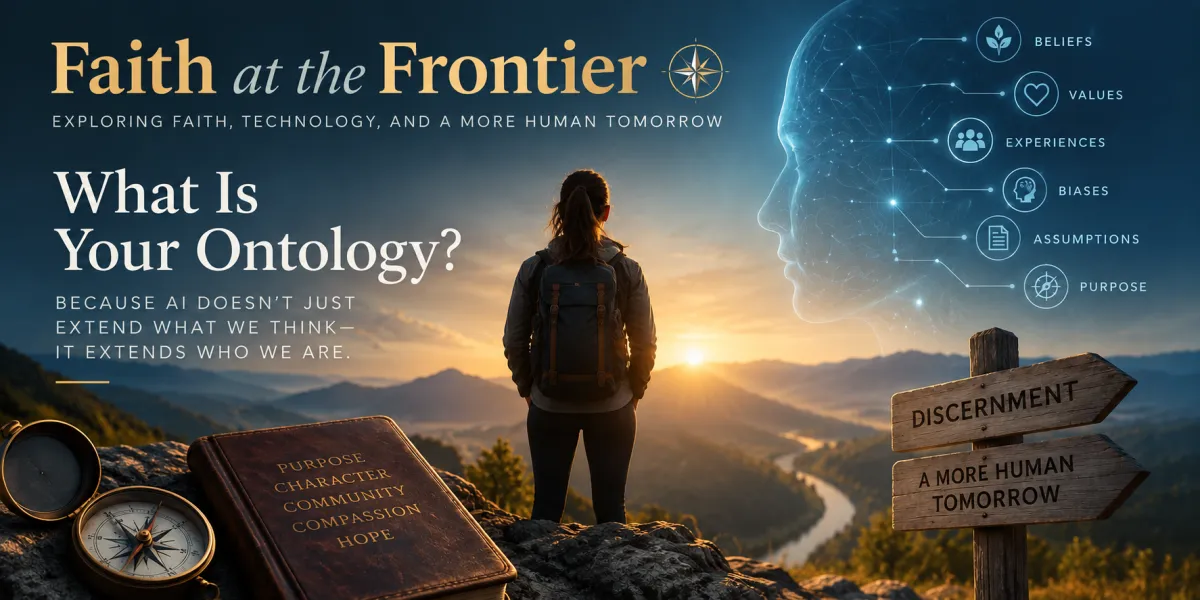
#AITransparency: Faith at the Frontier is directed, curated, and edited by Nathan Swenson-Reinhold using a deliberately developed theological, coaching, and leadership lens. ChatGPT and Manus AI assist with research, source triangulation, synthesis, and drafting within that framework. Nathan reviews sources and retains responsibility for the newsletter's theological interpretation, editorial judgment, and final content. Banner art was produced using ChatGPT.