What Counts at Thanksgiving
What Counts at Thanksgiving
Faith at the Frontier
Exploring AI human agency and the way of faith|November 24 2026
The Inner Frontier
There are 113 of you who receive Faith at the Frontier each week.
In newsletter terms, that is a really small number. The list is growing, but slowly, and I am fine with that. Nearly every week, one of you sends me a note to say this work helped you think, preach, or lead. I do not take those notes for granted.
So, before anything else this week, I want you to hear me say in response: thank you.
Though this evolved out of my own attempt to stay on top of the AI development cycle, this does take effort to produce externally facing content that has existential cash value. So it is heartening to know this work is not for naught.
I am grateful that you make room for questions that do not have easy answers. I am grateful for the trust involved in letting me accompany your thinking about technology, ministry, and what it means to remain human together.
When I see 113 on the subscriber dashboard, I have to remind myself that the number is made up of people. Each of you brings your own work, community, hopes, and concerns to this conversation.
Here at Thanksgiving, this work and your engagement of it feel like a tremendous blessing. And I am more than grateful.
From the Frontier
The age of scale
Last week, NVIDIA reported $115.8 billion in quarterly revenue, including $107.6 billion from its data-center business. Both numbers had more than doubled from the previous year. The company described its momentum as real and its ambition as greater than ever.
I can write those figures, but I cannot really picture them. They tell us how quickly demand for AI infrastructure is growing. They also show how much economic power is gathering around a small number of companies.
They do not tell us whether human beings are flourishing.
A new Harvard Business School working paper studied nearly 117,000 startups founded across 172 countries. The paper warns that AI may reach users around the world without building companies, investment, and durable economic capacity around the world. Access can spread while ownership and opportunity remain concentrated.
I am not suggesting that scale is inherently bad. AI infrastructure can produce real benefits, and revenue, investment, speed, and reach all matter. They simply cannot tell us everything we need to know. The danger comes when what is easiest to count quietly becomes what counts most. For those of you in congregational ministry contexts, average weekly worship attendance comes to mind.
Signals from the Frontier
The European Commission is trying to make one question harder to avoid: who may bear the consequences of a high-risk AI system? It has opened consultation on a common template for assessing fundamental-rights impacts before certain systems are deployed. The template is still a draft, so it is far too early to claim that it will prevent harm. But asking the question before deployment matters.
Meanwhile, the New Apostolic Church announced that it is developing recommendations for AI in sermon preparation and pastoral care. Its leaders drew a helpful boundary. AI may assist with research and structure, but it cannot believe, pray, love a congregation, or answer before God for what it says. The recommendations themselves have not yet been published.
The Human Landscape
What we may notice too late
In an essay titled After the Spectacle, biblical scholar Ki-Eun Jang reflects on what happened to the world of professional Go after AlphaGo defeated Lee Sedol. Winning was only the beginning. AI began changing how players understood creativity, intuition, excellent play, and the long apprenticeship through which a distinctive style emerged.
The standards changed before the community had fully named what the former standards meant. Values carried through years of practice became easier to recognize once they were already disappearing.
Jang's question bothered me more than the familiar question of whether AI will replace a particular job. What happens when a technology changes the meaning of good work before we have decided what good work is for? We may not notice when availability begins standing in for care, or when output begins standing in for wisdom.
Thanksgiving offers a small interruption. Gratitude asks us to pay attention before loss makes attention unavoidable.
A Faithful Lens
Gift before usefulness
Christian faith begins with gift. We receive life before we achieve anything, and grace before we earn anything. Our neighbors are not valuable because they are efficient, competitive, or impossible to replace. They are valuable because they exist - as Genesis tells us, in the image of God.
This makes conversations around AI and work interesting. There are many who are terrified of the disintermediating effect AI will have on knowledge workers in particular. It's interesting to see, often in these outcries, the conflation of human beings with their doings, as if they only places that human purpose and identity may emerge are in their chosen vocations. However, AI is giving us the ability to reflect on who or what should be doing what. Some tasks should disappear, and some tools genuinely free people from drudgery. Expertise will change. Christian hope does not require us to pretend otherwise. It also invites us to locate our identities outisde of our doings.
Christian hope does refuse one conclusion: that a person becomes less worthy when a machine can perform one of that person's tasks. No one's dignity depends on being the one worker a machine can never replace. We belong to one another because God has joined us to one another in a world God loves.
A Hopeful Practice
Name what speed might hide
Before asking what AI can make faster this week, name one person, practice, or human capacity you do not want the speed of AI to teach/cause you to overlook.
Then thank someone whose contribution cannot be captured adequately in a metric.
Be specific. Name what they have given, how it has mattered, and what would be missing without them.
Around the Table
At a Lehigh University summit on AI and assistive technology, people with disabilities and researchers kept returning to a practical principle: if you are building technology for people with disabilities, include them on the team. AI can help people communicate, understand legislation, navigate physical spaces, and design adaptations. But the technology also has to work, be affordable, and respect the agency of the people expected to use it.
There is a Thanksgiving lesson here. People who are often described as beneficiaries also carry knowledge the rest of us need. Gratitude makes room for them at the table and takes their agency seriously.
An AI Concept to Know
Proxy measure is something measurable that stands in for something harder to see. Revenue may become a proxy for value. Output may become a proxy for good work. Engagement may become a proxy for relationship. A proxy can be useful, but trouble begins when we forget that it is only an approximation of what we actually care about.
Worth Your Attention
·After the Spectacle: Ki-Eun Jang asks which values AI may change before we have learned to name and protect them.
·Frontier Technology in Frontier Markets: A working paper examines the unequal geography of AI entrepreneurship and investment across 172 countries.
·AI-Enabled Assistive and Rehabilitation Technologies Summit: Disabled people, researchers, and practitioners ask what makes AI assistance useful, affordable, and trustworthy in practice.
·Fundamental Rights Impact Assessment Template: The European Commission is seeking feedback on how deployers of certain high-risk systems should assess consequences before deployment.
A Word for the Way
"The eye can never say to the hand, 'I don't need you.'"
1 Corinthians 12:21 NLT
At a frontier captivated by what can be replaced, Christian community begins with a different confession: I need you.
Thank you for being part of this one.
Sources
1.NVIDIA Announces Financial Results for Third Quarter Fiscal 2027. NVIDIA, November 17, 2026
2.Frontier Technology in Frontier Markets. Gilles Q. Hacheme, Ebehi Iyoha, Abdoulaye Ndiaye, and Noureini S. Souleymane, Harvard Business School working paper, November 2026
3.After the Spectacle. Ki-Eun Jang, Contending Modernities, November 18, 2026
4.AI-Enabled Assistive and Rehabilitation Technologies Summit. Lehigh University, November 19, 2026
5.Fundamental Rights Impact Assessment Template. European Commission, November 16, 2026
6.Moving Forward Thinking Ahead Continuing the Journey. New Apostolic Church International, November 20, 2026
#AITransparency
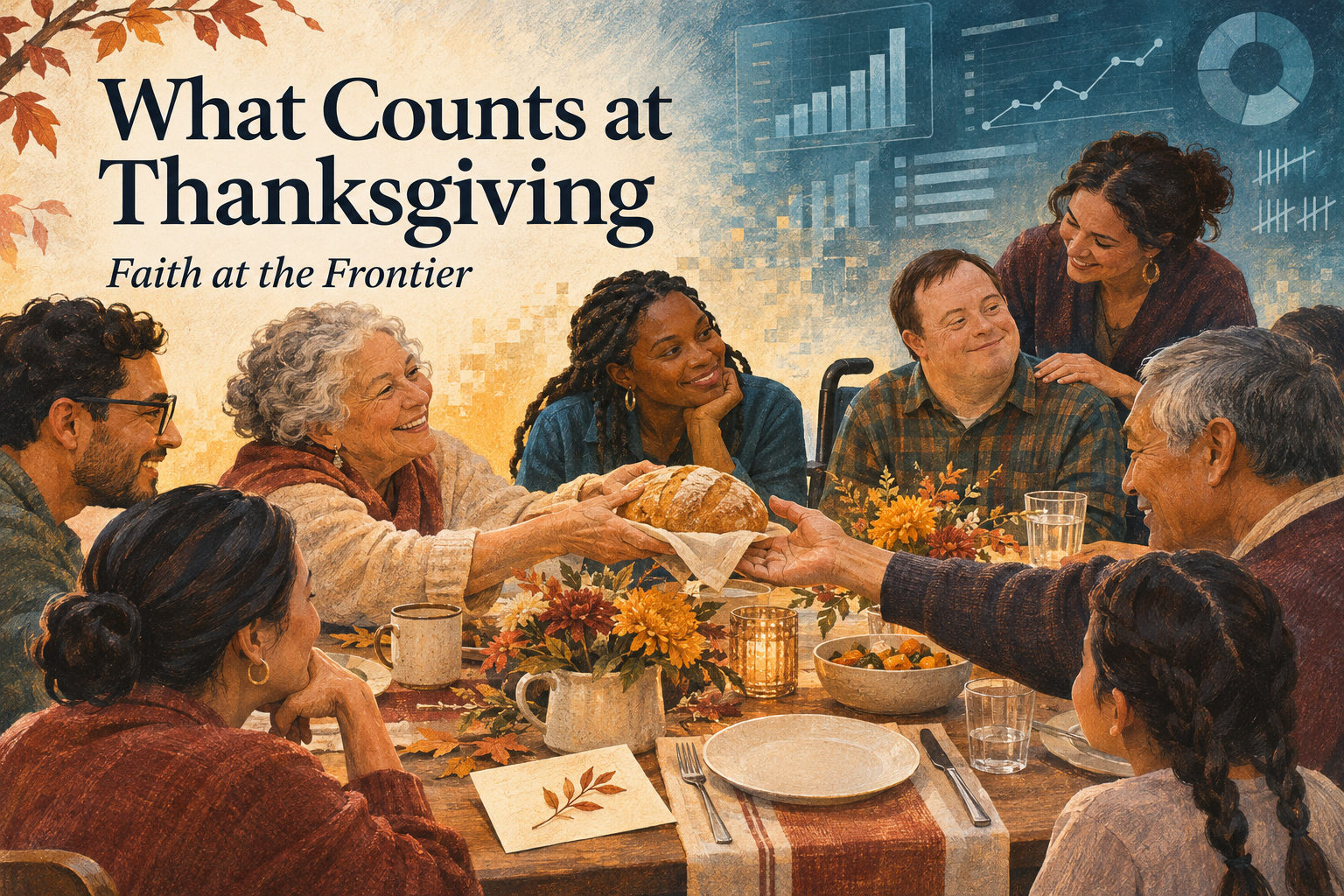
Faith at the Frontier is directed, curated, and edited by Nathan Swenson-Reinhold. ChatGPT and Manus AI assist with research, synthesis, and drafting. Nathan reviews sources and retains responsibility for the newsletter's topical direction, theological interpretation, editorial judgment, and final content. The banner artwork was created with ChatGPT.