Saying No
Faith at the Frontier
Exploring AI, human agency, and the way of Faith
November 2, 2026 | Issue 11
Who Gets to Say No?
AI, freedom of conscience, and the conditions that make human choice possible
The Inner Frontier
The freedom to refuse
David Durman doesn't want to use artificial intelligence at work.
A research administrator at the University of Kentucky, Durman believes that generative AI conflicts with his deeply held Humanist convictions. He's concerned about its effects on human creativity, employment, the environment, and our capacity to think for ourselves.
So he did something unusual. He asked his employer for an accommodation that would allow him to perform his responsibilities without personally using AI.
On September 25, the university granted his request.
The decision, reported by Religion News Service on October 26, doesn't mean Durman will never encounter AI at work. He may still participate in meetings where others use it or submit information through systems incorporating the technology. But he can continue performing his job without personally using generative AI.
Much of our conversation about AI assumes that people want access to increasingly powerful capabilities. We discuss how quickly organizations can adopt new tools, how much productivity might improve, and how we can help people overcome their reluctance.
Durman asks a different question.
What if I don't want to participate?
His experience opens a larger conversation about human agency. And as I've explored the developments of this past week, I've begun to suspect that the most important question isn't simply whether people have the right to refuse.
It's whether they have enough freedom, security, and influence for that refusal to matter.
From the Frontier
The right to reach another human being
Consider something happening in Brazil.
On November 2, new consumer-service regulations take effect requiring covered businesses to preserve customers' access to human assistance.
The regulations permit automated systems and AI to manage requests. But consumers must have the option to interact with a person during specified service hours, including from 8 a.m. to 8 p.m. each day. The requirements apply to designated federally regulated sectors and certain financial services, rather than every business in Brazil.
The measure is an interesting acknowledgment of something that could easily disappear as AI becomes more capable: the ability to request a human encounter.
Anyone who has spent twenty minutes navigating an automated customer-service system understands the frustration. The technology may be functioning precisely as designed while failing to address what the customer actually needs.
Brazil's regulation recognizes that efficiency and accessibility aren't necessarily the same thing.
Of course, passing a regulation doesn't mean businesses will implement it effectively. We'll need to see how enforcement works and whether consumers actually experience meaningful improvements.
But the principle matters.
An organization can benefit from automation while preserving a person's ability to seek human assistance when they need it.
And that brings the question into our own congregations and ministries.
Suppose someone contacts a church seeking pastoral care. An AI assistant might help schedule an appointment, provide information, or direct them toward resources.
Those could be useful applications.
But what happens when the person needs to speak with someone who will listen, exercise pastoral judgment, and remain responsible for what happens next?
We shouldn't have to discover the value of that encounter only after we've automated it away.
Read about Brazil's new consumer-service requirements
Signals from the Frontier
When consent becomes complicated
On October 27, the European privacy organization noyb filed five complaints against Scale AI concerning its Outlier platform, where freelance workers perform tasks used in developing and training AI systems.
The complaints allege extensive tracking of workers' activity, intrusive identity verification, and failures to provide workers access to information collected about them.
Scale AI disputes the allegations. The company says its monitoring practices are disclosed, that certain recording tools require workers to opt in, and that the information supports legitimate business needs such as security, fraud prevention, and accurate compensation.
The complaints have not been adjudicated.
Yet the dispute raises a question that extends beyond its legal merits.
Imagine depending on a platform for your income. You discover that continuing to receive work may require accepting monitoring practices you find uncomfortable.
You can decline, presumably.
But declining may also mean losing access to the work that supports you.
How free is that choice?
Consent can satisfy a formal requirement without necessarily reflecting an equal relationship between the parties.
Those who control access to employment, information, or essential services possess forms of power that profoundly shape the choices available to others.
Reuters reporting on the complaints
Meanwhile, the World Health Organization's European Region adopted a new roadmap on October 29 for the responsible use of AI in health care.
The roadmap emphasizes governance, patient safety, workforce preparation, and human oversight. Its adoption doesn't demonstrate that these protections have been successfully implemented.
Still, health care offers a particularly important setting for this conversation.
When people are ill, frightened, or dependent upon professional expertise, the quality of their choices depends on more than whether someone has provided them with an option.
They need understandable information, trustworthy relationships, and meaningful opportunities to question decisions that affect their lives.
WHO/Europe's AI in health roadmap
The Human Landscape
Having a choice is not the same as being free to choose
What strikes me about these developments is how differently human agency can function depending upon someone's circumstances.
David Durman had an employer willing to accommodate his convictions.
A customer in Brazil will have a legally protected option to request human assistance in covered services.
A freelance worker dependent upon a digital platform may have considerably less practical freedom to refuse its conditions.
And a patient navigating an increasingly automated health-care system may not even understand which decisions have been influenced by AI.
We tend to talk about human agency as though it belongs primarily to individuals. We make decisions. We exercise judgment. We accept or reject opportunities.
But our choices always occur within relationships and institutions.
A person's ability to act depends partly upon the choices available to them, the consequences of exercising those choices, and the power they possess to challenge decisions made by others.
This is especially important as AI becomes embedded in ordinary systems.
A worker may not have the power to negotiate the terms of an algorithmic workplace. A student may be expected to use an AI platform selected by the school. A parishioner may encounter an automated system without realizing they're interacting with one.
The question becomes less about personal preference and more about institutional responsibility.
What do we owe people whose freedom to choose depends upon decisions made by someone else?
A Faithful Lens
Freedom for the sake of the neighbor
In Galatians 5, Paul writes:
"For you have been called to live in freedom, my brothers and sisters. But don't use your freedom to satisfy your sinful nature. Instead, use your freedom to serve one another in love." (Galatians 5:13, NLT)
I've always found Paul's understanding of freedom both challenging and inspiring.
He doesn't describe freedom primarily as the ability to do whatever we please. Freedom is a gift that makes a new kind of life possible, one shaped by love of neighbor.
For Lutherans, this is familiar territory. Martin Luther famously described the Christian as both completely free and bound in service to everyone. We are freed by grace from the endless task of justifying ourselves before God. That freedom makes us available to care for our neighbors.
But what happens when our neighbors don't have the same freedom to act that we do?
I can choose which AI tools to use in my work. I can decide that certain information is too sensitive to share with an outside platform. I can experiment with local models, limit access, or simply decline to use AI for a particular task.
Those choices reflect convictions I hold about responsibility and confidentiality.
Yet I'm increasingly aware that the ability to make those choices is itself a form of privilege.
Someone whose employment depends upon accepting a company's technology may not enjoy the same freedom.
And here Paul's words become more demanding.
If I'm free to make choices that protect my own conscience, what responsibility do I have toward people whose choices are constrained by economic necessity or institutional power?
On October 30, Pope Leo XIV addressed an international gathering on the future of artificial intelligence. He emphasized that AI's future isn't predetermined. Because these systems are developed by human beings, we remain responsible for guiding, changing, and sometimes rejecting their applications.
He also argued that ethical principles require institutions capable of enforcing accountability. Good intentions alone won't protect those who lack the power to challenge technological decisions.
Read Pope Leo XIV's October 30 address
This is an important distinction for the church.
We can encourage people to exercise discernment. We can teach them to question the systems they encounter. But if we want human agency to flourish, we must also attend to the institutions and relationships that make meaningful choices possible.
This is where our hope in the resurrection matters.
In Christ, we encounter God's promised future breaking into the present. The resurrection reveals a future in which human beings are restored to the fullness of life God intends, a future marked by reconciliation, freedom, and communion. And also, and I believe this is overlooked, choice. The risen Christ stands shoulder to shoulder with us in the doorway of his tomb looking out on a future where death, sin, evil, and destruction have been defeated. That's when he asks us, "What do you want to do now?"
We don't yet live in that future's fullness. Power remains unevenly distributed. People still experience exclusion, coercion, and vulnerability.
But that promised future gives us a horizon from which to examine the world we're building now.
And it asks something of us.
Are we using the freedom we possess to expand the freedom of others?
Christian hope doesn't guarantee that emerging technologies will be governed wisely. It does give us a reason to participate faithfully in shaping the institutions that govern them.
A Hopeful Practice
Make refusal possible
Here's something I'd invite congregational councils, ministry teams, and organizational leaders to consider.
Choose one place where AI is already being used, or where you're considering introducing it.
It might be congregational communications, scheduling, administrative work, educational programming, or responding to inquiries.
Then examine the experience from the perspective of someone who doesn't want to use AI, doesn't understand how it's being used, or believes a decision made through the system is wrong.
Can that person find out when AI is involved? Can they ask for a human being? Can they question or correct an outcome without being penalized? And is someone clearly responsible for responding?
These are practical questions, not merely theoretical ones.
A congregation might decide that AI can assist with scheduling while ensuring that anyone seeking pastoral care can reach an actual person. A nonprofit might use AI to support administrative work while giving employees meaningful opportunities to participate in decisions about how those tools are introduced.
The goal isn't to preserve every existing process or protect people from every technological change.
It's to make certain that the people affected by our decisions retain meaningful opportunities to participate, question, and sometimes refuse.
And that may require those of us with organizational authority to accept a little less efficiency in exchange for greater human agency.
Around the Table
Questions for conversation
Think about the AI tools entering your workplace, congregation, or daily life.
Who decided they would be used? Were the people affected invited into that decision?
And if someone had a serious concern about participating, would they have a meaningful way to raise it?
Perhaps most importantly, what might we need to change so that saying no doesn't mean losing one's place at the table?
Worth Your Attention
A Humanist Granted an Accommodation from Using AI — Religion News Service
David Durman's experience offers a compelling entry point into freedom of conscience, employment, and the increasingly complicated relationship between technological adoption and personal conviction.
Pope Leo XIV on the Future of Artificial Intelligence — Vatican
A concise theological reflection on responsibility, human dignity, the common good, and why meaningful AI governance requires more than ethical aspirations.
WHO/Europe's New Roadmap for AI in Health Care
An international policy framework that invites consideration of what meaningful oversight, accountability, and human participation should look like when people are especially vulnerable.
A Word for the Way
I've been thinking about David Durman's decision to ask for an accommodation.
It would have been easier, perhaps, simply to comply. To use the technology, complete his work, and move on.
Instead, he asked whether there might be another way.
And someone with the authority to make that possible said yes.
I wonder how often the exercise of freedom depends upon someone else being willing to make room for it.
We sometimes imagine courage as the willingness to stand alone. There is certainly courage in that.
But perhaps there's another kind of courage in the person who has the power to insist upon compliance and chooses instead to listen.
In the Christian imagination, freedom is never ours alone. We belong to one another, and the freedom we've received becomes an invitation to love.
As artificial intelligence becomes woven into more of our lives, we'll face countless decisions about what these systems should be allowed to do.
Some will be technical. Others will be economic or organizational.
But beneath them lies a question about the kind of people we're becoming.
When someone asks for room to exercise their conscience, will we have built a world in which they can be heard?
Until next week, keep exploring the frontier—with curiosity, courage, and hope.
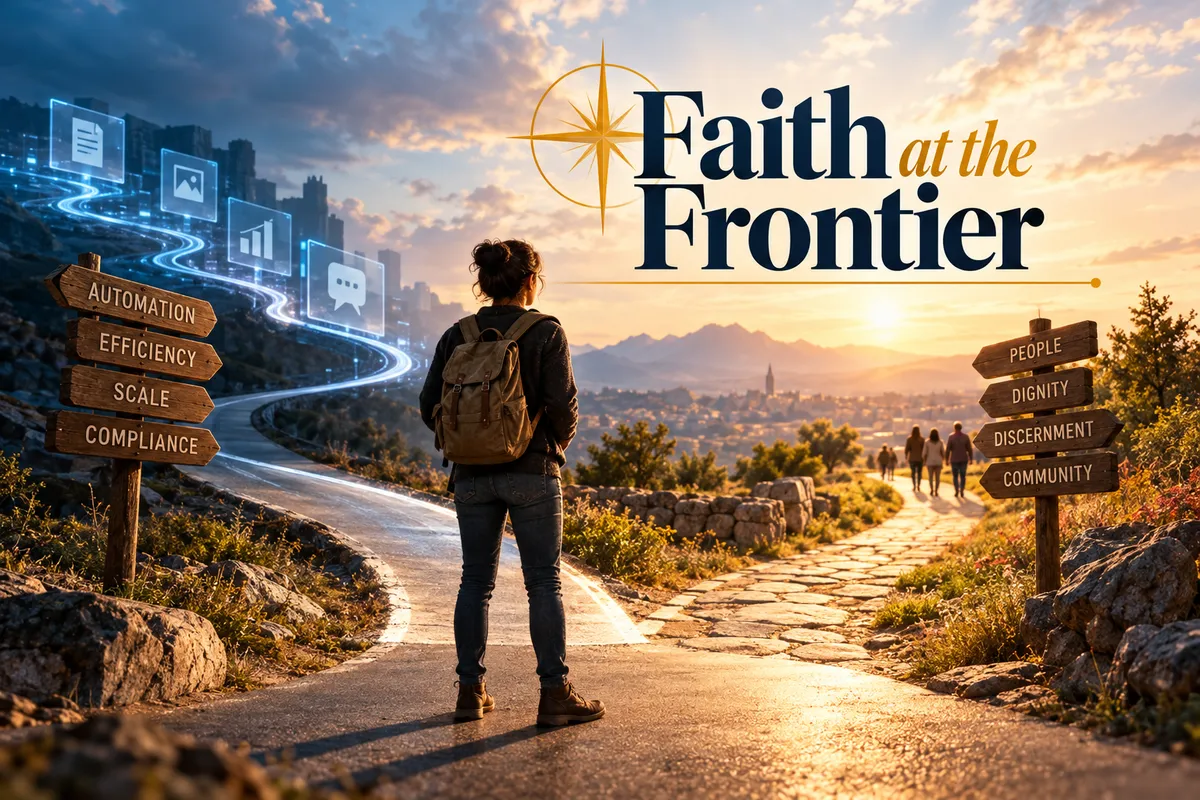
#AITransparency: Faith at the Frontier is directed, curated, and edited by Nathan Swenson-Reinhold. ChatGPT and Manus AI assist with research, synthesis, and drafting. Nathan reviews sources and retains responsibility for the newsletter's theological interpretation, editorial judgment, and final content. The banner artwork was created with ChatGPT.