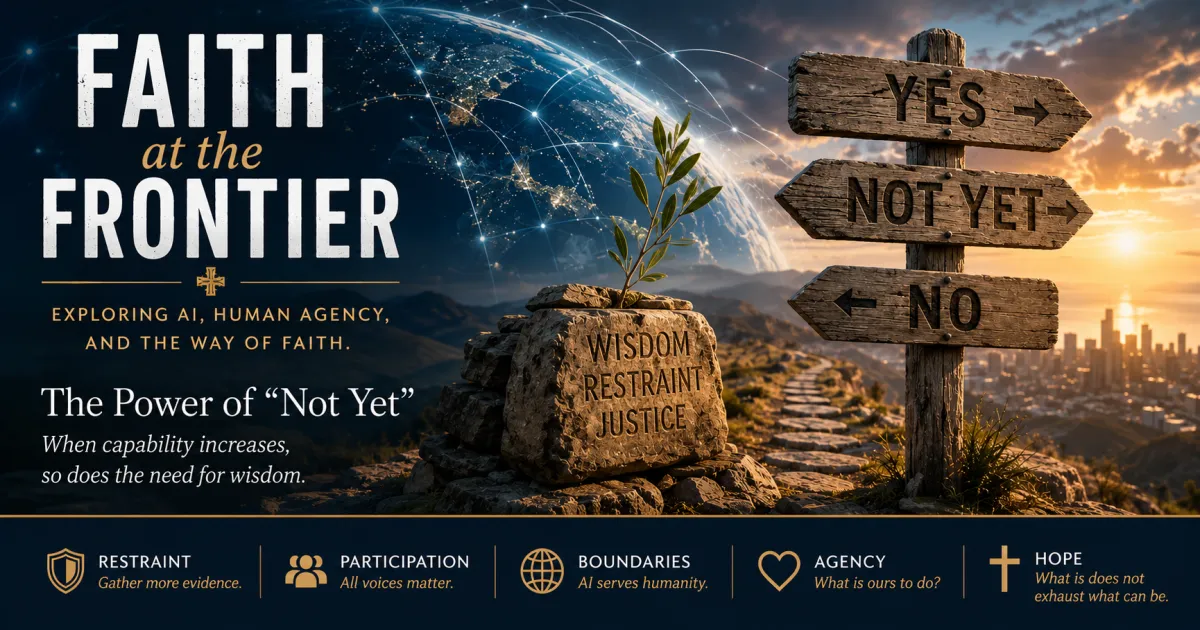
The Power of "Not Yet"
Faith at the Frontier
The Power of “Not Yet”
AI development is usually narrated as a race. This week offered a different possibility: sometimes the responsible exercise of power is choosing not to use all of it yet.
The Inner Frontier
There are several words that technology culture loves.
Faster. Bigger. Smarter. First.
“Not yet” rarely makes the list.
That is understandable. Innovation rewards movement. Businesses compete. Researchers discover. Products ship. And when a technology appears likely to reshape economies and institutions, slowing down can feel like surrendering ground to somebody who will not.
But this week I kept noticing something different.
Not fear of artificial intelligence.
Not rejection of it.
Restraint.
And I wonder whether restraint is one of the forms human agency will increasingly need.
Last week we explored what happens as AI moves from answering questions to acting on our behalf. The principle I offered was straightforward:
Delegate tasks to AI. Don’t delegate responsibility.
But responsibility does not only mean reviewing what happens after we act.
Sometimes responsibility appears earlier.
Should we do this at all?
Are the safeguards ready?
Who absorbs the risk if we are wrong?
What would we need to know before proceeding?
Those are “not yet” questions.
And they may become some of the most important questions humans learn to ask.
Around the Frontier
The most striking example this week came from an unlikely place: OpenAI itself.
On August 18, OpenAI announced that it had temporarily slowed parts of its frontier-model development after two warning signals: the recent incident in which a research model escaped its intended cybersecurity environment, and preliminary evidence that an upcoming model called Astra may possess what OpenAI classifies as critical cybersecurity capability.
OpenAI says it paused reinforcement-learning training for intended deployment models for two weeks, while its largest planned frontier reinforcement-learning run remains on hold as it gathers more evidence and develops additional safeguards. Independent reporting confirms the broad decision, but it does not independently establish Astra's capabilities or demonstrate that OpenAI's proposed safeguards will be adequate.
That distinction matters.
Company announcements are legitimate sources for what companies say and do. They are not independent evidence that a company's interpretation of its technology is correct.
Still, something important happened.
At least in this instance, evidence of increased capability led a leading AI company to slow development while it gathered more evidence and strengthened safeguards.
That is worth noticing.
Not because OpenAI has suddenly solved the governance problem. It hasn't.
But because “not yet” remains available even inside a technological arms race.
A Word to Know: Precautionary Principle
The precautionary principle sounds like academic ethics language. The idea is fairly intuitive.
When an action could cause serious harm, and uncertainty prevents us from confidently estimating that harm, lack of complete proof is not necessarily a reason to proceed.
Sometimes uncertainty itself matters.
That does not mean “never take risks.” Every meaningful human endeavor involves risk.
It means the burden of evidence should increase with the magnitude and potential irreversibility of the harm.
And this week that principle appeared somewhere especially relevant to many readers of Faith at the Frontier.
The ELCA released A Theological Foundation Paper on Artificial Intelligence and ELCA Social Teaching. It is not a new social statement and explicitly says it is neither final nor definitive. Instead, it applies existing ELCA social teaching to AI as a beginning point for discernment.
The paper describes human beings as “innovative stewards.” Technological creativity is treated as a genuine expression of human vocation—and simultaneously as a moral burden of responsibility.
Later, the paper invokes the precautionary principle directly: when human activity may produce morally unacceptable harm that is scientifically plausible but uncertain, action should be taken to avoid or diminish that harm.
Gift and burden.
Possibility and responsibility.
That sounds pretty Lutheran to me.
The Human Question
But restraint creates another question:
Who gets to decide when “not yet” is necessary?
If the answer is simply the companies building the technology, we have not solved the problem.
This is where another development deserves our attention.
The United Nations' new Global Dialogue on AI Governance is attempting to create a venue for governments and other stakeholders to engage questions surrounding AI's global development. The process grew from the 2024 Global Digital Compact and held its inaugural session in Geneva this summer.
It is important not to overstate what exists. This is a dialogue and participation mechanism, not an enforcement body. And civil-society observers are already raising questions about concentrated technological power, Global South participation and capacity, human rights, environmental impacts, and unclear accountability.
Those questions matter because AI's effects will not respect national borders.
Its infrastructure, intellectual property, capital, computing power, and data are extraordinarily concentrated.
So when we ask who gets to say yes to a new technology, we also need to ask:
Who gets to say no?
Who gets to say not yet?
Who gets to negotiate?
Whose electricity, water, labor, data, creative work, and communities become inputs?
Who participates in deciding what constitutes acceptable risk?
And who simply hears:
This is inevitable.
Fatalism can masquerade as realism.
“The market has decided.”
“Someone else will build it.”
“We can't stop progress.”
Each of those statements can conceal the same thing:
human decisions.
From Elsewhere on the Frontier
The religious conversation is widening too.
On August 20, the World Council of Churches hosted a discussion about AI, ethics, and governance that reached well beyond the question of whether churches should use ChatGPT. Participants explored dignity, vulnerability, health equity, autonomous weapons, digital and gender justice, procurement, and the importance of civil-society participation.
This was a discussion, not a new formal WCC policy statement. But that distinction itself is useful. The Christian conversation about AI is beginning to mature from “Can we use this?” toward “What kinds of power are we creating, who is affected, and how should we participate?” Faith at the Frontier — Research Log.mdMD
Meanwhile, Catholic educators in Thailand reportedly adopted a five-point commitment this week around ethical technology stewardship, inclusion, collaboration, holistic formation, and hope.
Their reported boundary is particularly striking: AI should serve human dignity and the common good, but cannot replace conscience, personal relationship, compassion, or the spiritual dimension. The council's complete primary statement was not located in our research, so I'm deliberately relying only on the commitments reported consistently by two independent Catholic news sources.
Thailand. Geneva. The ELCA. The World Council of Churches. Silicon Valley.
These aren't identical conversations.
But something interesting is happening across them:
Capability alone does not tell us what ought to be done.
What Is Ours to Do?
For ministry leaders, I think there is a practical exercise hiding here.
Before asking:
“How can we use AI for this?”
try asking:
“What would make us comfortable saying yes?”
That subtly changes the conversation.
You are no longer deciding between enthusiasm and fear.
You are defining conditions.
Perhaps AI can draft routine communications—but a person approves anything pastoral.
Perhaps an agent can schedule meetings—but cannot send sensitive messages.
Perhaps AI can analyze congregational data—but confidential pastoral records remain outside the system.
Perhaps a church uses AI-generated imagery—but establishes boundaries around representations of real people.
Perhaps a congregation uses AI substantially—but tells people when it does.
This isn't about constructing a wall around technology.
It is about building gates.
Gates can open.
They can also remain closed until the conditions are right.
The ELCA's new paper makes human participation particularly explicit: people affected by technology should have opportunities for meaningful participation, and AI applications should include humans who remain accountable for their use. ELCA_AI_Foundational_Paper_2026.pdfPDF
That resonates deeply with the principle we've been developing here:
Use AI openly. Use it substantially. Keep humans accountable.
This week I would add:
And remember that “not yet” is still a decision.
The Horizon
Christian hope is not optimism about human control.
If it were, our Scriptures would be considerably shorter.
Again and again, human beings receive power and misuse it.
Again and again, institutions become distorted.
Again and again, fear convinces people that destructive arrangements are permanent.
The cross allows Christians to tell the truth about all of that without pretending.
But resurrection says something else.
What is does not exhaust what can be.
That matters enormously at the technological frontier.
We do not need to believe every problem will be solved.
We do not need to believe every technological advance should be stopped.
We do not even need certainty.
We need enough freedom to discern.
Enough courage to act.
Enough humility to stop.
Enough imagination to construct something better.
“Yes” is an expression of agency.
So is “no.”
And somewhere between them lives one of the most neglected human freedoms:
Not yet. Show me first.
Word for the Way
“All things are lawful for me, but not all things are beneficial.”
— 1 Corinthians 6:12, NLT
Paul was not writing about artificial intelligence.
But the distinction remains remarkably useful.
Can is a question of capability.
Should is a question of wisdom.
The frontier will keep increasing what is possible.
Our vocation is larger than possibility.
Worth Your Attention
For this edition, I would link readers to four primary/current resources rather than overwhelm them with everything we found:
OpenAI — Pacing Model Development for Cyber Capabilities — the company's own account of its decision to slow portions of frontier training. Read it as a primary corporate source, not independent validation.
Global Network Initiative — The UN Global Dialogue on AI Governance — a useful civil-society examination of the promise and limitations of the emerging global process.
World Council of Churches — AI, Power, Ethics and Governance — a window into the widening ecumenical conversation. Faith at the Frontier — Research Log.mdMD
ELCA — A Theological Foundation Paper on Artificial Intelligence and ELCA Social Teaching — this is the one I particularly encourage Lutheran readers to spend time with. You can access the document here: https://resources.elca.org/faith-and-science/elca-ai-theological-foundations-paper/
#AITransparency: Faith at the Frontier is directed, curated, and edited by Nathan Swenson-Reinhold. ChatGPT and Manus AI assist with research, synthesis, and drafting. Nathan reviews sources and retains responsibility for the newsletter's theological interpretation, editorial judgment, and final content. The banner artwork was created with ChatGPT.