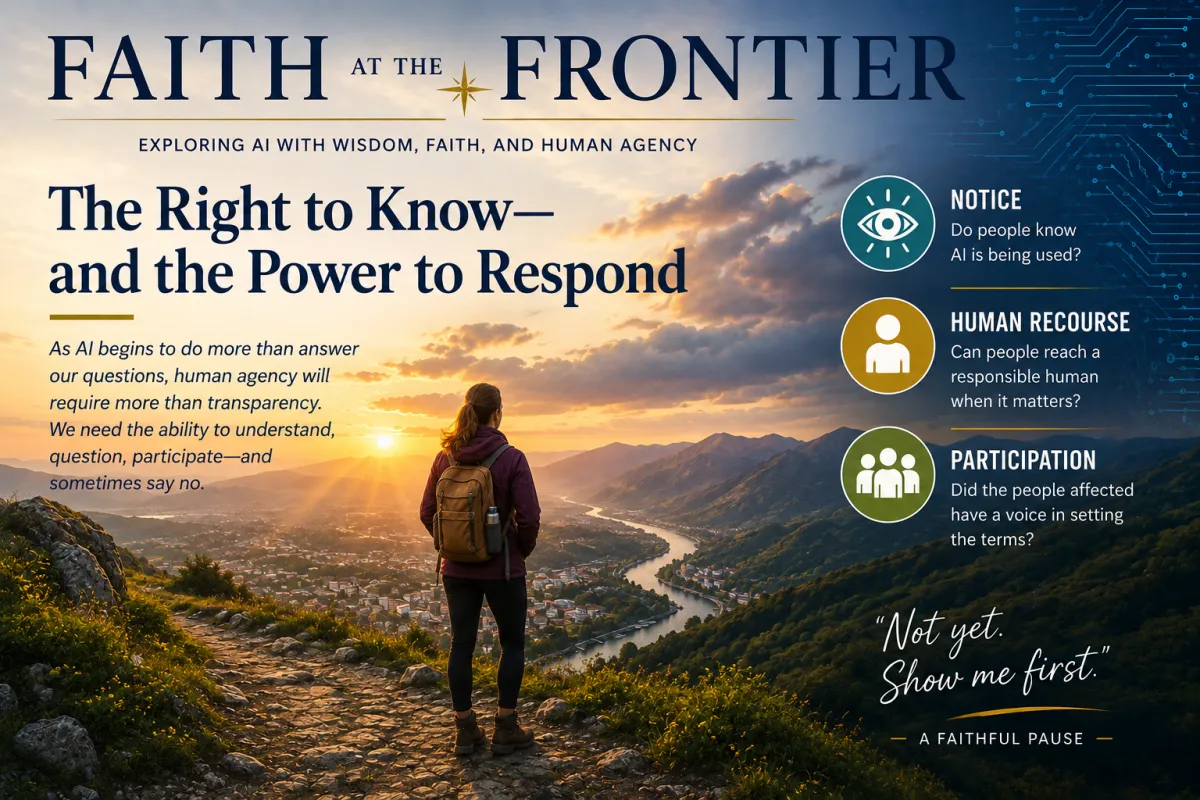
The Right to Know—and the Power to Respond
The Right to Know—and the Power to Respond
As AI begins to do more than answer our questions, human agency will require more than transparency. We need the ability to understand, question, participate—and sometimes say no.
The Inner Frontier
Something subtle is changing in our relationship with artificial intelligence.
For most of the brief history of generative AI, the interaction has been fairly simple:
We ask. AI responds. The interaction ends.
This boundary is beginning to move.
AI companies are developing systems that can use tools, pursue goals over longer periods of time, remember context, initiate additional work, and operate with increasing independence. WIRED reported this week that OpenAI is testing a “Persistent mode” for Codex that could continue working until stopped and generate follow-up tasks for itself. The feature has not been broadly released, and OpenAI says persistence does not expand the system's underlying permissions. wired.com
Still, the direction matters.
We are moving from asking AI to do something toward giving AI authority to act on our behalf.
Delegation has ethical implications and impacts.
But Manus's independent research this week helped me see another part of that question.
Before I can responsibly delegate authority—or live under someone else's decision to delegate it—I need to know that AI is there. Once we know that it is there, then we have the agency to respond.
From the Frontier: Show Us
The European Commission's AI Office has new enforcement powers under the EU AI Act. Those powers include requesting information from providers of general-purpose AI models, conducting evaluations, seeking access to models, requiring corrective measures, and—in serious cases—imposing sanctions or restricting a model's availability. digital-strategy.ec.europa.eu
This week, EU technology commissioner Henna Virkkunen told Euractiv that the Commission had begun using those powers, sending information requests to selected developers of advanced AI models. The requests reportedly concern cybersecurity, physical infrastructure protections, outside evaluation, safety recommendations, monitoring, and copyright. The Commission has not publicly identified the companies involved. euractiv.com
That distinction matters.
An information request is not proof that anyone has done something wrong. It is not proof that the systems are unsafe. And it certainly doesn't mean Europe has “solved” AI governance.
It means something much simpler:
Someone other than the company gets to ask questions.
Show us what you tested.
Show us what you know.
Show us how you monitor what happens.
Show us what happens when something goes wrong.
The questions reveal that AI still exists within the framework of human social contracts at the local, national, and even international levels.
Power becomes more accountable when someone has the standing to ask it for an answer.
The Human Landscape: Knowing Isn't the Same as Having a Say
Healthcare gives us a much more personal example.
New Pew Research Center data released this week found that 72% of U.S. adults say it is extremely or very important that healthcare providers tell them when AI is being used in their care.
People want disclosure even for some surprisingly mundane uses. Seventy-two percent say they should be told when AI takes notes during an appointment. Sixty-four percent want to know when it orders prescription refills. Even for appointment scheduling, 56% want disclosure. pewresearch.org
But another finding may matter more.
53% say they have little or no say over whether AI is used in their healthcare.
And 63% would like more say. pewresearch.org
There is an important distinction here.
Transparency says:
AI was used.
Agency asks:
And what can I do about it?
Can I ask questions?
Can I request a human?
Can I challenge a decision?
Can I understand what information was used?
Can I decline?
Can I appeal?
A disclosure notice without any meaningful capacity to respond can become little more than a ritual.
Visibility is not the same thing as agency. But visibility is one of agency's necessary conditions.
From the Church: The Questions Are Already Arriving
This week's most immediately useful development for faith leaders may have happened in Nashville.
At the ecumenical AI & Church Summit, ministry practitioners, chaplains, theologians, and technology specialists unveiled a new Church AI Toolkit.
The scenarios it addresses aren't science fiction.
A grieving parent develops a relationship with a chatbot built from a dead child's digital footprint.
An older adult receives a fraudulent call using a cloned voice.
A young person becomes deeply attached to an AI companion.
A worker faces displacement.
A pastor encounters a congregant whose relationship with AI has become part of their grief, loneliness, fear, or sense of identity.
The toolkit includes pastoral triage, formation resources, organizational preparation, case studies, and tools for discerning whether AI belongs in particular ministry tasks. One resource walks ministry leaders through five gates before deciding whether to use AI for a particular task. churchaitoolkit.com
I don't want to oversell this.
The toolkit is new. Its creators describe it as evolving, and questions have already been raised about field testing, theological and clinical review, accessibility, and whether sufficiently diverse communities participated in its development. pcusa.org
That's healthy.
Because the church does not need to become the place where everyone suddenly becomes an AI expert.
It can become something more important:
a place where human beings can bring what is happening to them and be accompanied while they make sense of it.
Pastoral competence has never required knowing everything.
It requires knowing how to remain present when something important is happening.
The Global Question: Who Is the “We”?
There is another danger hidden inside conversations about human agency.
We can say:
We should decide how AI shapes our future.
But who exactly is we?
Manus's research this week uncovered an important pairing.
At a UN regional convening on AI and human development in Xi'an, China, discussions emphasized that Asian histories, experiences, values, youth, labor, and development concerns need to participate in global AI governance.
Meanwhile, a newly published systematic review examining African participation in AI argues that meaningful inclusion involves far more than making technologies available in Africa. It includes participation in data production, model development, innovation, governance, and decisions about how these systems affect African societies.
That changes the question.
Representation isn't simply inviting more people into the room after the important decisions have already been made.
It means asking:
Who owns the data?
Who builds the infrastructure?
Who has access to the technology?
Who bears its environmental and economic costs?
Who sets the standards?
Who gets to say yes?
Who gets to say no?
And—as we explored last week—who gets to say:
Not yet. Show me first.
A Word to Know: Human Recourse
We talk frequently about human oversight in AI.
I think another phrase may be equally important:
human recourse.
Oversight asks whether a human is somewhere in the system.
Recourse asks whether the person affected by the system can actually reach one.
Imagine an AI system makes or influences a decision about your healthcare, employment, insurance, education, finances, or access to assistance.
A human may technically supervise that system.
But can you reach that human?
Can you explain what the system missed?
Can you contest the decision?
Can someone change it?
That is recourse.
And it gives us a useful three-part test for consequential AI:
Notice → Human Recourse → Participation
Notice: Do people know AI is being used?
Human recourse: Can people reach a responsible human being when something matters or goes wrong?
Participation: Did the people affected have any meaningful voice in setting the terms?
That is a much richer standard than simply putting “AI-generated” on something.
A Faithful Lens
Christian faith makes a rather extraordinary claim about human beings.
Our worth does not come from our efficiency.
It does not come from our intelligence.
It does not come from our productivity.
And it certainly does not come from our ability to outperform machines.
Human dignity precedes all of those things.
That conviction changes how Christians might approach AI.
The question isn't whether humans can maintain technological superiority.
We almost certainly won't in many particular tasks.
The deeper question is whether the systems we build and the institutions that deploy them honor the dignity and agency of the people whose lives they touch.
The Theology of the Cross asks us to tell the truth about what is.
And what is includes enormous asymmetries of power.
Technology companies build systems most people cannot inspect. Institutions increasingly deploy tools people may not understand. Communities can absorb economic, ecological, and social consequences of decisions made far away.
But Christian hope refuses fatalism.
The future is not owned by the systems presently shaping it.
Which means the question remains:
What is ours to do?
A Hopeful Practice: Conduct an Agency Audit
Here's something almost any congregation, nonprofit, school, or ministry can do this week.
Choose one place where AI is already being used—or is likely to be used soon.
Then ask four questions:
Where is AI acting?
What is the system actually doing?What do people know?
Would someone affected reasonably know AI was involved?Where is the human recourse?
If something is wrong, confusing, harmful, or simply inappropriate, who can a person reach?Who helped set the terms?
Were the people affected by this use represented when the decision was made?
These aren't anti-technology questions.
They're governance questions.
They're leadership questions.
And I would argue they're questions of neighbor-love.
Around the Table
Here's a question for your church council, staff, leadership team, or dinner table:
Where have we accepted technological convenience without making sure people can understand it, question it, or refuse it?
Don't begin by asking whether the technology is good or bad.
Ask instead:
Where does the human being still have meaningful agency?
Worth Your Attention
WIRED — OpenAI Is Developing a “Persistent” AI Agent
European Commission — AI Office Enforcement Powers
Euractiv — EU Requests Information From Leading AI Labs
Pew Research Center — Americans Want Transparency When AI Is Used in Healthcare
Presbyterian Church (U.S.A.) — Pastoral Care in the Age of AI
Church AI Toolkit — “Should I Use AI for This?”
A Word for the Way
I've been thinking about Paul's words:
“Now we see things imperfectly, like puzzling reflections in a mirror.”
— 1 Corinthians 13:12, NLT
Paul wasn't writing about artificial intelligence.
But he understood something about the human condition.
We never see everything.
Our knowledge is partial.
Our judgment is imperfect.
And yet we are still called to love, choose, act, and take responsibility for one another.
Perhaps that is part of what faithful life on this frontier requires.
We don't need perfect knowledge before we act.
But neither should we surrender our agency simply because the systems around us are difficult to understand.
We can ask to see.
We can ask questions.
We can insist upon a human response.
We can invite those affected into the decisions.
And sometimes we can say:
Not yet. Show me first.
The future is not happening without us.
#AITransparency: Faith at the Frontier is directed, curated, and edited by Nathan Swenson-Reinhold using a deliberately developed theological, coaching, and leadership lens. ChatGPT and Manus AI assist with research, source triangulation, synthesis, and drafting within that framework. Nathan reviews sources and retains responsibility for the newsletter's theological interpretation, editorial judgment, and final content. Banner artwork is created with ChatGPT.