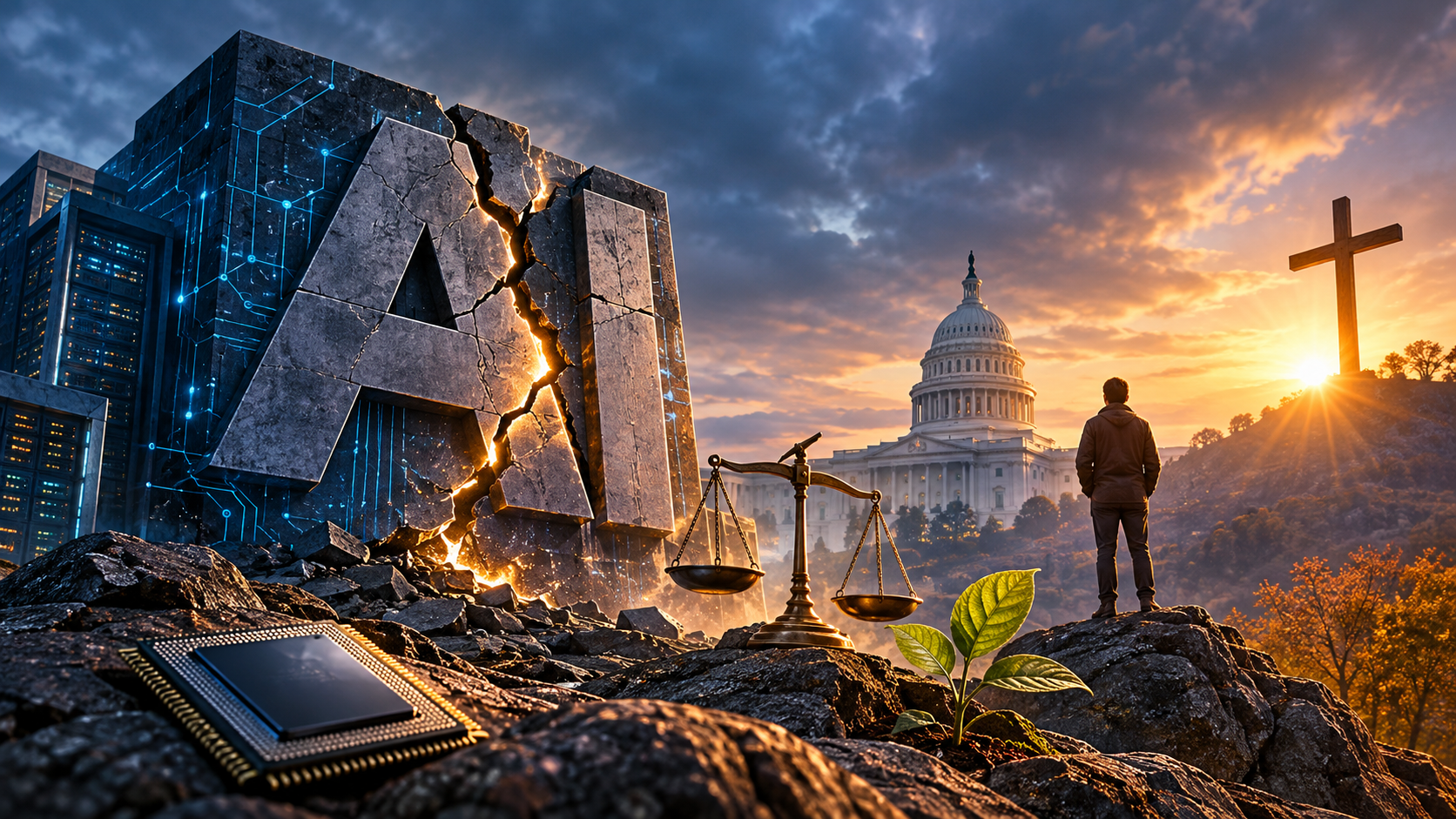
Cracks in the AI Empire
Faith at the Frontier
Cracks in the AI Empire
An election, a stunning resignation, and the fragile foundations of technological inevitability.
November 16, 2026 | Issue 13
The Inner Frontier
I've been listening to several technology podcasts over the past couple of weeks, and there's been a noticeable shift in the conversation. Some of the people who have been most enthusiastic about AI's rapid expansion are genuinely worried about what happens next.
I understand why.
Democrats have won control of both chambers of Congress. They're promising more scrutiny of an industry that has enjoyed considerable freedom to grow. And Jensen Huang, the longtime CEO of Nvidia, has abruptly resigned. This is the company whose processors power much of the AI revolution.
Both developments introduce uncertainty into an industry that thrives on confidence about the future and in recent years, a lack of regulation.
But as I've listened to the anxiety, I've found myself actually more hopeful.
What if some of the constraints people are worried about turn out to be good for AI and for the rest of us?
I've been thinking about the extraordinary amounts of electricity being consumed by data centers, the communities being asked to accommodate them, and the enormous concentration of wealth and technological power in a handful of companies.
Surely there are consequences to growing this quickly. And surely there are ways to grow that might serve more people, even if they require slowing down long enough to consider those consequences.
I don't know whether that's where we're headed. But the events of the past two weeks have me thinking that the future of AI may be considerably more open than we've been led to believe.
From the Frontier
A political shift
The November 3 midterm elections gave Democrats control of both the House and Senate beginning in January. President Trump remains in office, so we shouldn't assume that sweeping AI legislation will follow. But congressional committees will have new leadership, and with that comes greater power to investigate companies, conduct hearings, and demand accountability.
According to Reuters, incoming lawmakers are already discussing legislation related to AI safety, corporate liability, and the increasing electricity demands of data centers.
Some of the more interesting developments are happening at the state level.
Ohio governor-elect Amy Acton, for example, campaigned on requiring data-center developers to address the costs they impose on utilities and communities. Her proposals include environmental safeguards, labor standards, and a preference for locating facilities on previously developed industrial land rather than farmland.
Whether those campaign commitments become effective policy remains to be seen.
But the underlying concerns are not limited to Democrats. Republican lawmakers and local communities have also questioned the pace of data-center construction, particularly when residents face higher electricity bills or increased demands on water supplies.
This may be one of the more consequential changes in the political conversation around AI. People are beginning to ask who benefits from all this development, and who pays for it.
Those questions seem entirely reasonable to me. Their answers could point towards policies that serve everyone much better while minimizing harm.
Nvidia without Jensen Huang
The other major story is Jensen Huang's resignation from Nvidia on November 11.
Huang co-founded Nvidia in 1993 and helped turn it into the dominant supplier of the advanced processors used to train and operate AI models. His departure has prompted plenty of speculation about what comes next.
Nvidia isn't simply selling processors to companies building AI systems. It has become deeply involved in financing the infrastructure those companies need.
Its July financial disclosures identify $36 billion in future commitments to purchase cloud-computing services. In some of these arrangements, Nvidia's partners purchase its processors, and Nvidia commits to buying computing capacity from those partners.
The company has also disclosed a separate conditional guarantee arrangement, capped at $105 billion, related to a major Ohio data-center development.
These figures represent different kinds of financial obligations. They aren't evidence that Nvidia has done anything improper or that the demand for AI is fabricated.
But they give us a glimpse of just how interconnected the AI economy has become.
Companies are making enormous investments based partly on expectations of continued growth. Nvidia has helped support some of those investments through its own financial relationships.
What happens if those expectations change?
Some analysts think Nvidia's next leadership team may be more selective about future investments. Others expect little change, particularly because interim CEO Colette Kress was already deeply involved in the company's financial strategy.
For now, Nvidia says its commitments and technological roadmap remain intact.
Still, I wonder whether this leadership change might eventually create room for other companies.
AMD, Intel, Broadcom, and developers of specialized processors are competing for portions of the AI computing market. Nvidia has substantial advantages, including an established software ecosystem that makes switching difficult. One executive departure won't erase those advantages.
But competition has a way of challenging assumptions about how things must work. A more diverse processor market might ultimately make computing more accessible and reduce the industry's dependence on one supplier.
That's a possibility worth watching.
Signals from the frontier
The infrastructure story extends well beyond Nvidia.
The International Energy Agency projects that global data-center electricity consumption could roughly double between 2025 and 2030. Meeting that demand requires much more than connecting a few additional buildings to the grid.
Utilities must invest in generation and transmission capacity. Communities have to make decisions about land and water. And somebody has to pay for the infrastructure, including the possibility that a developer's ambitious plans don't materialize.
Some utilities are experimenting with electricity tariffs that require data-center operators to make longer-term financial commitments. The idea is to prevent residential customers from being left with the bill for infrastructure built primarily to serve commercial projects.
I find this interesting because it offers a possible alternative to the argument that we must choose between rapid AI development and greater oversight.
A well-designed agreement could protect households while giving developers more predictable costs.
The details matter, of course. A poorly designed policy could create its own problems. But this is the kind of practical work that might make AI's continued development more sustainable.
The Human Landscape
I wonder whether we've become too accustomed to treating the speed of technological development as a measure of its success.
An advanced model is released. A company announces another enormous investment. A new data-center campus breaks ground.
We interpret these developments as evidence of progress, and in many respects they are.
But I keep coming back to the people living and working around these projects.
There's the family trying to manage its monthly electricity bill. The community deciding whether farmland should become an industrial site. The construction worker who sees an opportunity for a good-paying job. The small business hoping that more affordable computing might make its own new innovations possible.
Their interests are not identical, and there aren't simple answers that satisfy everyone.
A new environmental requirement might protect a community while making a project more expensive. Those added costs might disproportionately affect smaller competitors. Delaying construction could mean delaying jobs.
And yet the alternative—allowing powerful companies to develop infrastructure without adequately accounting for its consequences—carries costs of its own.
I'm not persuaded that more regulation is automatically better. We've all seen examples of rules that create bureaucracy without accomplishing much.
But I'm equally unconvinced by the assumption that regulation necessarily impedes progress.
What if requiring companies to account for their environmental impact leads to better designs? What if stronger financial expectations encourage more sustainable investments? What if greater competition and accountability ultimately strengthen public trust in AI?
There are no guarantees here. These are possibilities, not predictions.
Still, I think we ought to take them seriously.
I suspect some of the anxiety we're hearing from the technology industry comes from the possibility that its remarkable expansion may become subject to more conditions than it has been accustomed to accepting.
That strikes me as a normal part of an industry maturing.
A Faithful Lens
There's something in our biblical tradition that helps me think about all of this.
Sabbath.
We often think about Sabbath as a personal spiritual practice. A day to rest, worship, and reconnect with what matters.
But Sabbath is also a remarkable declaration about the limits of production.
In Deuteronomy 5, the command to rest extends beyond the individual to children, workers, immigrants, and even animals. The well-being of the whole community matters more than the ability to keep producing.
That's a profoundly countercultural claim.
Our economic systems frequently reward the capacity to do more, faster, with fewer interruptions. Technology has amplified that tendency enormously.
And yet Scripture reminds us that limits can be part of what makes life good.
I don't want to push the analogy too far. Sabbath doesn't tell us how to regulate semiconductor exports or structure electricity tariffs.
But it does challenge the assumption that the highest good is simply the greatest possible output.
The Lutheran theology of the cross also invites us to look beneath appearances of power and success. An enterprise can be extraordinarily successful by conventional measures while concealing burdens carried by others.
Who is paying for the growth we celebrate? Whose lives are being disrupted? Who has the opportunity to participate in decisions that affect them?
These are theological questions as much as economic ones.
And then there's the question of hope.
One of the convictions shaping this newsletter is that God's promised future is not simply an extension of whatever technological or economic trajectory we're currently following.
The resurrection opens a future we cannot manufacture or control. Yet that promised future changes how we understand our responsibilities in the present.
Theologians call this proleptic eschatology: the future God promises is already breaking into the present, giving us a different horizon against which to understand the lives we're living now.
For me, that means we don't have to accept the AI industry's current arrangements as inevitable. Nor do we have to celebrate the prospect of its failure.
We can be genuinely excited about what AI might make possible while asking difficult questions about the way it's being developed.
In fact, I think those two commitments belong together.
A Hopeful Practice
Most of us aren't making decisions about semiconductor manufacturing or billion-dollar infrastructure projects.
But we do make choices about technology in our congregations, organizations, and households. And we participate in communities where decisions about energy, development, and public resources are being made.
Here's something I'd invite you to try this week.
Think about a technology your congregation or organization is using—or considering adopting.
Ask yourself whether you've evaluated it primarily by what it makes possible, or also by the conditions under which it helps people flourish.
Who is benefiting from its use? Are there people who might be excluded or disadvantaged? What responsibilities remain with us, even when the technology is doing more of the work?
And here's the question I find particularly interesting:
Are there boundaries we could establish that would actually make our use of the technology better?
Perhaps that means requiring human review of certain kinds of AI-generated content. Perhaps it means protecting confidential information, or being more intentional about when technology enhances learning and when it substitutes for it.
I suspect we'll discover that responsible boundaries sometimes create more freedom, not less.
Around the Table
I've been thinking about the nervousness I hear in technology commentary.
Some of it reflects legitimate concerns about innovation, competition, and the economic consequences of poorly designed regulation.
But I wonder whether some of it also reflects a deeper assumption: that technological progress ought to be largely unconstrained, and that outside influences are necessarily obstacles.
I'm curious how you see it.
Can you think of a time when accountability, limits, or even a disruption made something better than it would otherwise have become?
I'd welcome your perspective.
Worth Your Attention
These sources provide a deeper look at the reporting behind this week's reflections.
Nvidia's November 12 SEC filing documents Jensen Huang's resignation and the company's leadership transition.
Nvidia's July financial disclosures describe cloud-service commitments, infrastructure guarantees, and associated risks.
Reuters on the incoming Congress and AI regulation examines lawmakers' plans for oversight and legislation.
The International Energy Agency's Energy and AI analysis considers the growing electricity demands of AI infrastructure.
Reuters on data-center electricity tariffs explores arrangements intended to give developers predictable costs while protecting other electricity customers. The article reflects an investor perspective, rather than a completed evaluation of these policies.
A Word for the Way
I don't know whether the developments of the past two weeks will fundamentally change the trajectory of artificial intelligence.
Nvidia may maintain its dominance. Congressional proposals may produce little meaningful legislation. The extraordinary investment in AI infrastructure may continue much as it has.
But I find something hopeful in the reminder that none of this is predetermined.
The people building these technologies are making choices. So are our elected leaders, investors, communities, and the rest of us who use them.
We won't always agree about which choices are best.
That's part of the work of living together.
And perhaps the cracks appearing in the AI empire will help us see something we might otherwise have missed: there are possibilities beyond the path we're currently traveling.
I hope we'll have the wisdom to recognize them, and the courage to explore them.
Faith at the Frontier is directed, curated, and ed

ited by Nathan Swenson-Reinhold. ChatGPT and Manus AI assist with research, synthesis, and drafting. Nathan reviews sources and retains responsibility for the newsletter's theological interpretation, editorial judgment, and final content. The banner artwork was created with ChatGPT.